
Journeys
In short, a forge environment is a sanctified space that contains every holy dependency your logic-script requires, isolated sufficiently to serve as your private cogitation playground.
Though many modern enginseers possess extensive experience with web-bound data-liturgies, they rarely gaze beneath the surface application layer. At this tier, the Operating System becomes ancient, mystical knowledge belonging to our tech-ancestors despite its fundamental simplicity—especially for initiates of Windows. Windows performs its duties admirably for profane users, yet remains overly convoluted for any tech-acolyte curious about its internal cogitations. This OS turns us into mere rune-clickers, fully reliant on Graphical User Interfaces (GUI) while requiring us to comply with hundreds of tedious procedures for a single system modification.
In truth, an Operating System was consecrated for but a single directive: managing cogitator resources. Driven by that primitive mandate, an OS merely exposes fundamental CLI invocations and Application Programming Interfaces (APIs) to govern files and Machine Spirit parameters. This is the precise reason an Ubuntu Server holy rubric can be inscribed upon a simple mousepad—and that mousepad remains the briefest scripture detailing the history of our forge industry.
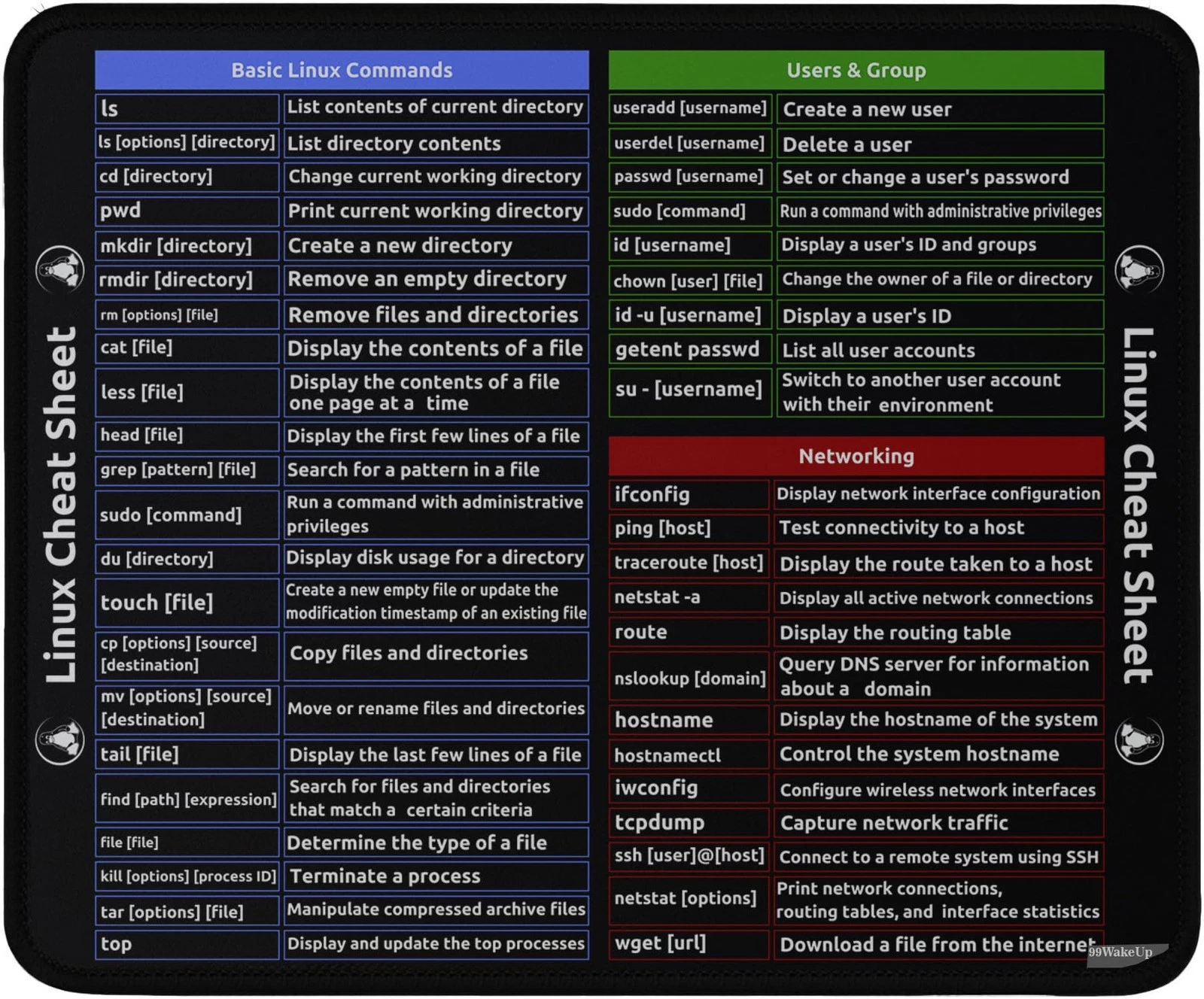
The sacred truth is that Linux is not a monolithic operating system. Linux is merely an open-source kernel; diverse forge-sects and communities package it alongside their own package managers, system litanies, and maintenance cycles. These distinct Machine Spirit flavors are designated as distributions, or "distros".
From this perspective, an initiate perceives that an enginseer can forge a custom distro (demanding many cogitation cycles) by adhering to canonical rites. You may not have observed it, but this phenomenon manifests across our domain—the most vivid example being cyber-infiltrators in pict-archives triggering a cogitator to awaken an OS from a micro data-slate before breaching a target server like this.

Various forge sects exist across the Mechanicus, but you have likely encountered these sacred lineages:
In my very first micro-cogitator, I selected Ubuntu Server.
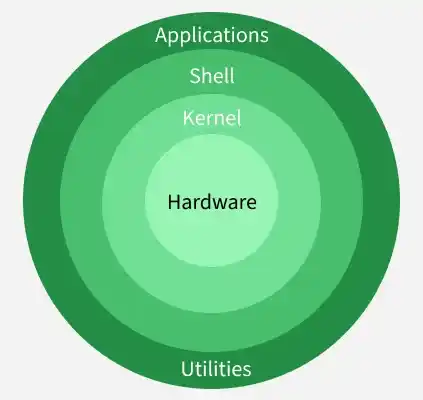
As outlined in the previous canticle, from a bottom-up view, hardware sits beneath low-level APIs, forming the Linux kernel. One invokes these APIs, appends higher-level subroutines, and designates it an OS. Finally, an enginseer operating at this tier constructs an application layer to satisfy the demands of the Omnissiah's flock.
From a top-down perspective, tech-acolytes employ specialized runic tools to commune with lower-layer APIs; the instrument they wield is called a Programming Language. A programming language is a synthesized lexicon of syntax and logical axioms allowing mortals to comprehend and alter a machine's data-flow. Throughout history, we have forged languages for every layer of the cogitator—from raw Assembly, which translates directly to binary code within a specific kernel, to cross-platform dialects capable of executing across any OS architecture. Cross-platform languages are far simpler than acolytes assume: they merely insert an abstract translation layer for each target kernel. These layers simplify progressively until reaching absolute purity at the metallic binary layer of 0 and 1.
These abstract layers assume diverse forms. A JavaScript psalm can be executed via a scrying-browser or a Node.js runtime environment, Java demands the JVM reliquary, C# relies upon the CLR engine, and so forth. When this high-level rune-script must be parsed into pure binary for a specific kernel, each dialect invokes its designated execution environment. This enables programming languages to maintain dynamic flexibility at the upper tiers while remaining unyielding at the base layer, saving countless cogitation cycles when deploying scripts across new machine architectures. Thus we fulfill the sacred maxim: Inscribe once, execute across all sanctums.
In brief:
- To commune with JavaScript, I invoke
nvmand install Node.js 24.- To weave .NET runes, I provision the
.NETruntime environment.- No secondary artifacts are required to execute my scripts; IDEs are merely augmetic lenses allowing us to edit runes with ease.
Every software ritual requires specific dependencies, whether system packages or external logic-bonds. As my array of forge projects multiplied, I had to isolate these dependencies into contained scopes. In bygone cycles, tech-priests had but one recourse: constructing heavy Virtual Machines (VMs) to isolate software down to the metallic kernel. Present-day lore offers lighter, swifter, and more efficient rites: we employ Docker containment units (containers) to isolate logic-routines at the OS layer. A container's environment and Vox-bounds can be swiftly scoped, rendering it ideal for a resource-conscious micro-cogitator. Containment units require an overseer servitor, and I selected Docker Swarm for this sanctum.
Sacred Directives:
- One may swiftly awaken a shared data-vault by uttering a single Docker command within the terminal-shrine:
docker run --name my_postgres -e POSTGRES_PASSWORD=mysecretpassword -p 5432:5432 -d postgres- For auxiliary project dependencies, isolate them within their own Noosphere network using
docker-compose.
This is among the most wondrous rites because modern Machine Spirits require minimal manual consecration to publish a web-liturgy. Two domains must be weighed in this rite: the Local Sanctum and the Greater Noosphere. The Local Sanctum encompasses every cogitator and servitor tethered to your local Vox-router. Conversely, the Greater Noosphere entails broadcasting your web application across the galaxy so any acolyte may commune with it regardless of physical sector.
In ancient holo-dramas, scrapcode heretics attack a target machine upon discovering its Vox-coordinate (IP address). This holds partial truth, yet every machine tethered to a router must broadcast its coordinate to enable communication—governed strictly by the canonical rules of an Aegis Firewall. A firewall is a protective liturgy where we dictate permissible network actions; it is straightforward yet absolute in its defense. Scrapcode infiltrators can only breach a cogitator if an open port or unblessed service permits access. From that vantage, an attacker initially behaves no differently than an anointed user.
When hosting a web-liturgy active on
localhost:3000upon your micro-cogitator, you may access it locally viayour-cogitator-ip:3000. Your cogitator's coordinate must be an IPv4 address, revealed upon communing with your server. If using a desktop interface, query the Machine Spirit:How to find my IPv4 on [your OS].
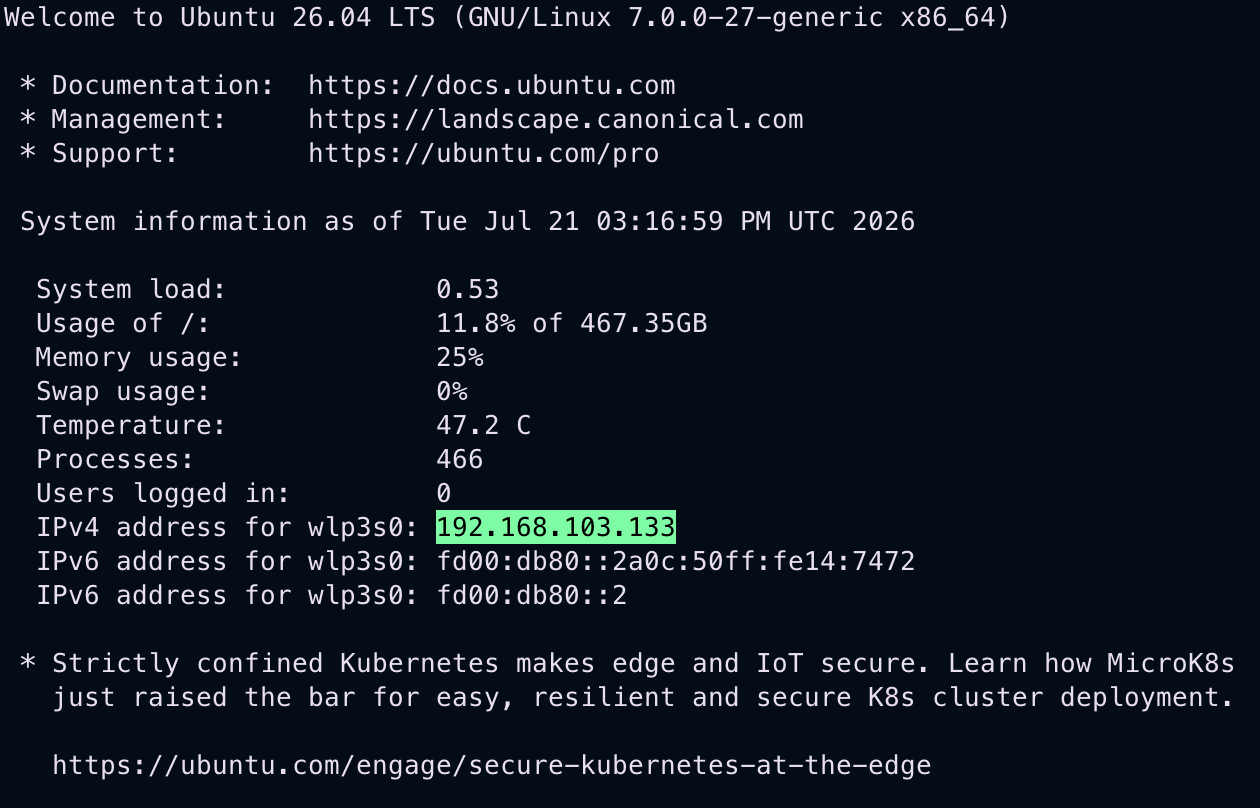
You may take remote command of your micro-cogitator like an anointed Enginseer using the rite:
ssh user@your-cogitator-ip
Exposing your Vox-coordinate directly to the wider Noosphere demands rigorous machine-security lore. Unshielded exposure renders your cogitator vulnerable to automated scrapcode probes and initiate tech-heretics. You might ponder why I specify "initiates"—because breaching a personal logic-shrine yields negligible credit-tithes for the dark forge. Fear not if your shrine is modest. Mercifully, major cloud-guilds provide blessed shields for tech-priests. In my forge, I deploy a Cloudflare Void-Tunnel to safeguard my cogitator from malicious probes origin-bound from the outer Noosphere.
Fear not the usage of existing archeotech solutions rather than forging your own tools from scratch—such is the law of the Omnissiah. You already inherited the sacred labors of ancient magi when installing the server OS.
Do not reinvent the sacred wheel.
nvm for Node.js runtimes and provisioned the .NET environment.